Bar Type LCD Displays
Stretched, ultra-wide TFTs for clusters, shelf edges and equipment status.
1 matching display module
Refine in Display Finder →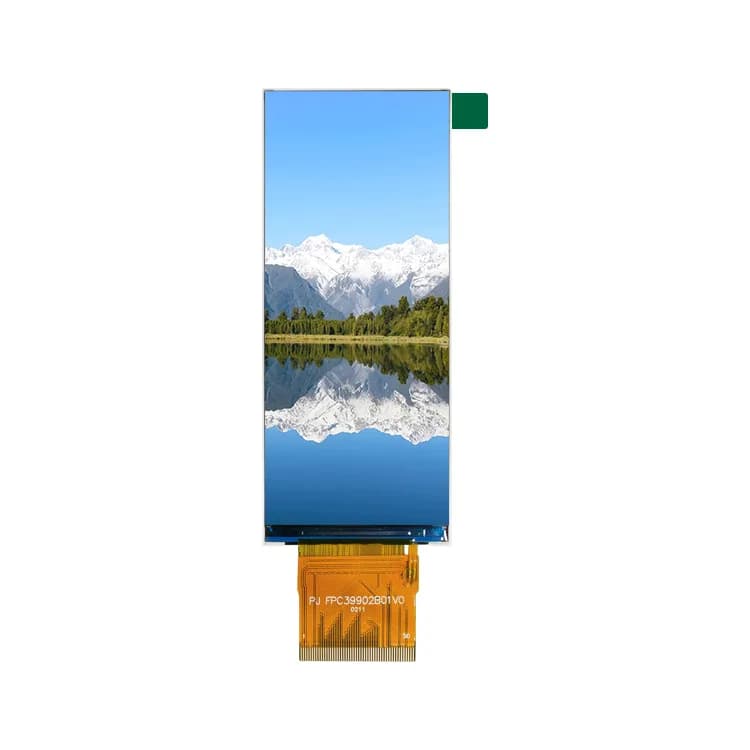
More standard models (8)
Full catalog →From our direct factories’ product tables. Datasheets and samples on request.
| Model | Size | Resolution | Interface | Brightness (cd/m²) | FPC pins | Viewing | Touch | Outline (mm) | |
|---|---|---|---|---|---|---|---|---|---|
| PJ2002G10-25H40P200 PengJi | 2″ | 960×240 | RGB (parallel) | 200-400 | 40 | 12 o'clock | — | 46.1 × 40.96 × 2.6 | Full specs → |
| PJ2002C07-25H40P200 PengJi | 2″ | 960×240 | RGB (parallel) | 200-400 | 40 | All (IPS-type) | Optional | 46.1 × 40.96 × 2.53 | Request datasheet |
| PJ2703H04-25H40P300 PengJi | 2.7″ | 960×240 | RGB (parallel) | 300-500 | 40 | All (IPS-type) | — | 39.2 × 68.2 × 2.75 | Request datasheet |
| PJ2703H03-25H40P200 PengJi | 2.7″ | 960×240 | RGB (parallel) | 300-500 | 40 | 6 o'clock | — | 45.80 × 62.7 × 2.5 | Request datasheet |
| PJ2702G02-28H40P200 PengJi | 2.7″ | 960×240 | RGB (parallel) | 300-500 | 40 | 6 o'clock | — | 39.1 × 68.15 × 2.76 | Request datasheet |
| PJT300C10H34-200P40N PengJi | 3″ | 960×240 | RGB (parallel) | 300-500 | 40 | All (IPS-type) | — | 43.44 × 75.31 × 2.8 | Request datasheet |
| PJ30LW002A PengJi | 3″ | 960×240 | RGB (parallel) | 300-500 | 40/39 | 6 o'clock | — | 43.44 × 75.31 × 2.8 | Request datasheet |
| PJ12301H02-76H40P700 PengJi | 12.3″ | 1920×720 | LVDS | 700 | 40 | All (IPS-type) | — | 308.1 × 130 × 7.6 | Request datasheet |
How bar displays are made
There are two routes:
- Native bar panels are designed with an elongated cell from the start. Optical performance is uniform and supply is stable.
- Cut panels are made by cutting a standard panel and re-sealing it. This allows unusual sizes in low volumes, but lifetime and yield depend heavily on the cutting process.
Ask your supplier which type you are buying; it affects reliability data and long-term availability.
Portrait-native panels
Many bar panels are scanned along the long edge (for example 320×960 is often natively portrait). Your graphics stack must rotate the frame buffer. Check this before choosing a low-power MCU, because software rotation costs CPU time and memory.
Typical sizes
Size | Resolution | Typical interface | Application |
|---|---|---|---|
3.9″ | 480×128 | SPI / RGB | Equipment status |
4.58″ | 320×960 | SPI + RGB | Instrument clusters |
8.8″ | 480×1920 | MIPI | PC case and dashboard displays |
12.3″ | 1920×720 | LVDS / MIPI | Automotive-style clusters |
Design tips
Use large type and horizontal layouts. Bar displays are often viewed at an angle, so IPS panels are strongly preferred.
Frequently asked questions
What is a bar type LCD?
It is an ultra-wide TFT LCD with an aspect ratio of 3:1 or wider, used where a long, narrow display fits better than a standard 16:9 screen.
Are cut bar displays reliable?
They can be, but reliability depends on the cutting and re-sealing process. For long product lifecycles, native bar panels or suppliers with published reliability test data are safer.
Why does my bar display show the image rotated?
Many bar panels are portrait-native. Configure rotation in the display driver or UI framework rather than in the application.
Not sure which display fits your design?
Send us your size, interface and host processor. A display engineer replies within 12 hours with 2–3 options, datasheets and init code. Samples from 1 pc.