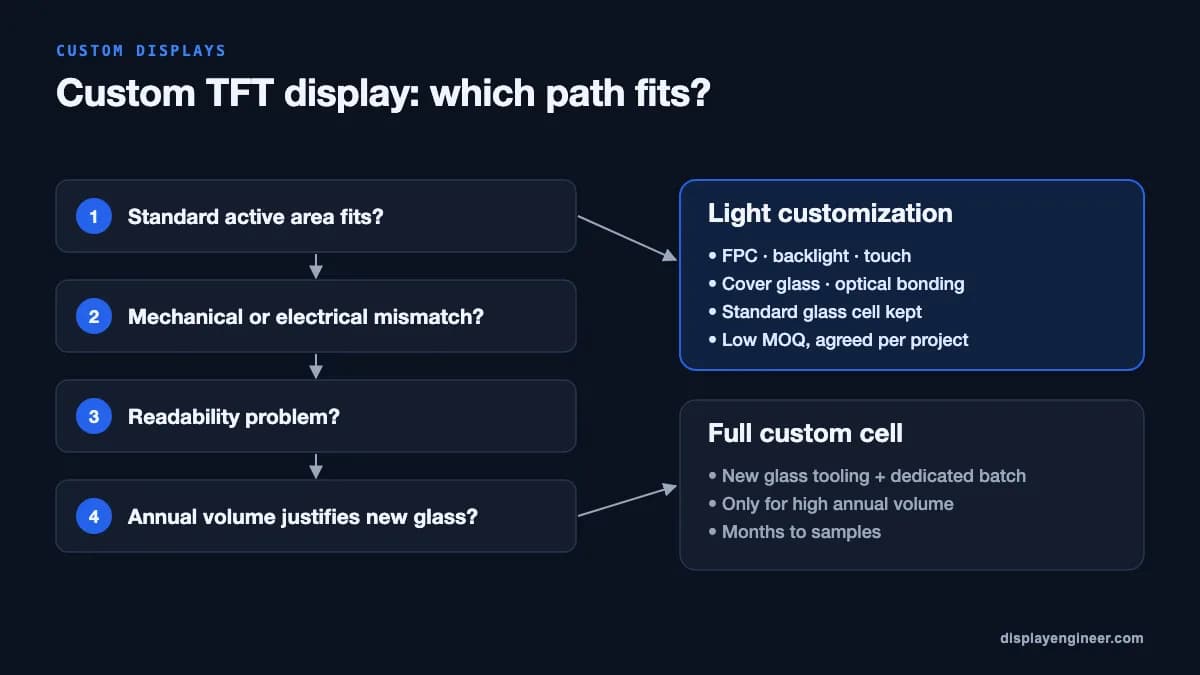
Start with four questions
- Does a standard active area fit? If a standard size shows what you need, keep its glass. Most enclosures can be adapted with a cover lens or frame.
- Is the mismatch mechanical or electrical? A connector, pin order or cable length is an FPC change. A bezel or mounting issue is a frame or cover-glass change.
- Is the problem readability? Brightness, glare and outdoor use are solved with the backlight, optical bonding and AR glass, not with new glass.
- Is your annual volume high enough for dedicated glass? Only then does a fully custom cell make economic sense.
If the answer to the first question is yes, you almost never need a custom cell.
What each change involves
Change | What is modified | Tooling | What to send us |
|---|---|---|---|
FPC | Length, shape, connector, pin order | Low | Your board connector and pinout |
Backlight | LED count, brightness, driver | Low if the outline is unchanged | Target brightness and power budget |
Touch | Capacitive or resistive panel, controller, tuning | Low to moderate | Glove, water and cover thickness needs |
Cover glass | Outline, thickness, printing, coatings | Low to moderate | Drawing or sketch, logo, coating |
Optical bonding | OCA or OCR between cover and panel | Process setup | Environment and readability target |
Full custom cell | Active area, resolution, glass outline | High | Volume forecast and a full specification |
Where the cost and MOQ come from
A TFT cell is built on large mother-glass sheets. A new active area or outline means new photomasks and cutting, plus a dedicated batch of glass, polarizers and driver ICs. Those materials cannot be reused for another product, so the factory needs an order large enough to absorb the setup.
Smaller glass sizes often carry higher MOQs, because more panels fit on each mother glass and a minimum batch produces more pieces.
Light customization avoids all of this. The glass cell stays standard, so it keeps its availability, reliability data and price, and only the parts around it change.
The cost drivers
Driver | Full custom cell | Light customization |
|---|---|---|
Glass tooling | High | None |
FPC tooling | Yes | Low |
Backlight tooling | Yes | Low if dimensions unchanged |
Cover glass / touch tooling | Yes | Low to moderate |
MOQ | High (dedicated glass batch) | Low, agreed per project |
Time to samples | Months | Confirmed with the quote |
Lead-time planning
Sample timing usually starts from drawing approval, not from the first email, so approve drawings quickly. Allow extra weeks around major holidays, especially Chinese New Year. We confirm the sample and production schedule with every quote.
Mistakes that add cost
- Changing the glass for a few millimetres. A cover-lens outline or frame usually solves the fit at a fraction of the cost.
- Specifying brightness without bonding. A brighter backlight behind an air gap often reads worse in sun than a bonded, moderately bright one.
- Freezing the mainboard first. If the board is fixed, every mismatch lands on the FPC. Share the connector early.
- Leaving out the annual volume. Volume decides which path is economical, so a quote without it is a guess.
Checklist before asking for a quote
Size or active area, resolution, interface, brightness, touch type, operating temperature, a mechanical sketch, target price and annual volume. Volume decides which path is economical.
See custom TFT displays, our sample policy or ask an engineer.
Frequently asked questions
Why is the MOQ so high for custom TFT displays?
A custom cell needs dedicated glass, masks and materials that cannot be used for any other product, and a production run costs about the same setup whether it makes 1,000 or 10,000 pieces.
How can I reduce custom display cost?
Start from a standard active area and customize the FPC, backlight, touch and cover glass instead of the glass cell itself.
Do samples have an MOQ?
Standard modules are available from 1 piece. Customized samples are usually built in small batches after tooling.
Can you change only the FPC?
Yes. An FPC change is one of the most cost-effective customizations and a common way to fit a panel to an existing mainboard.