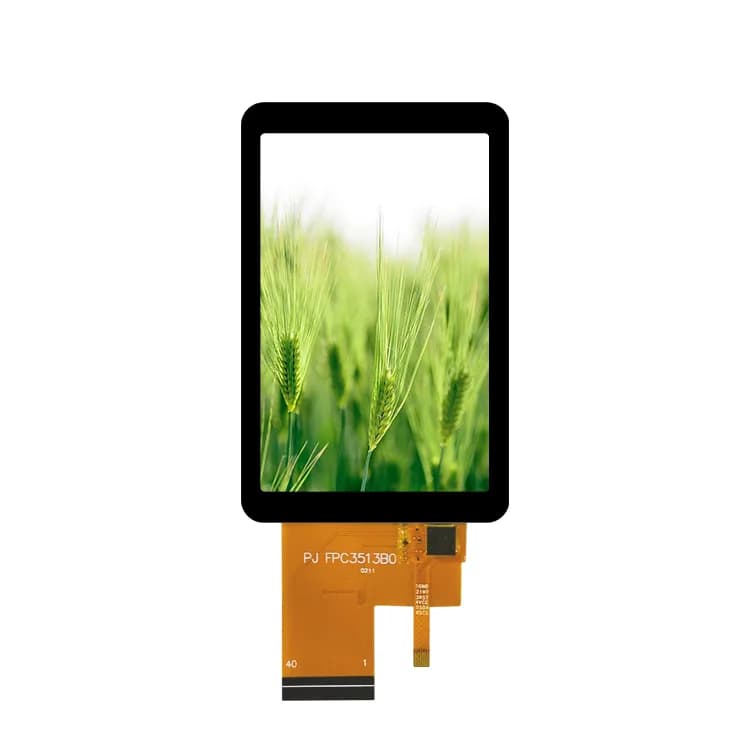
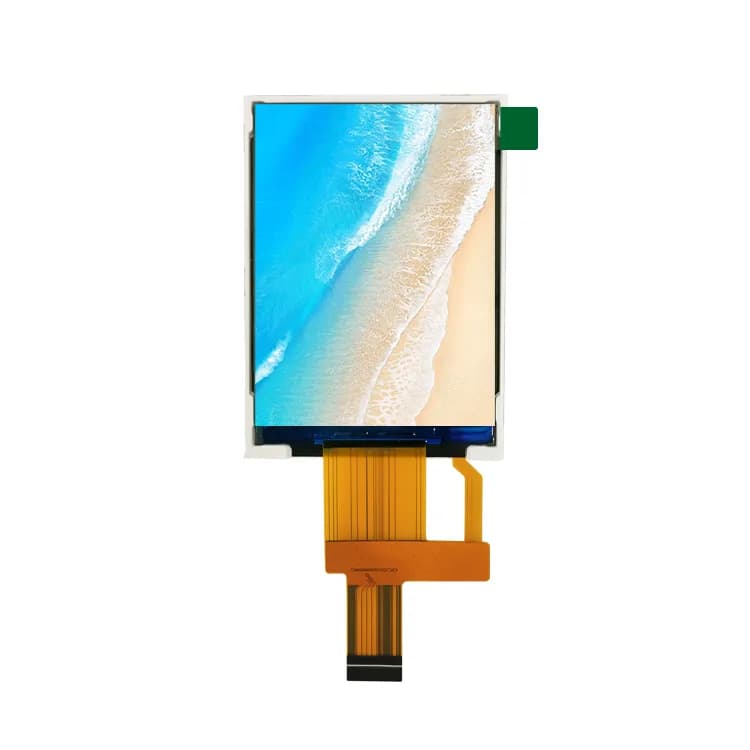
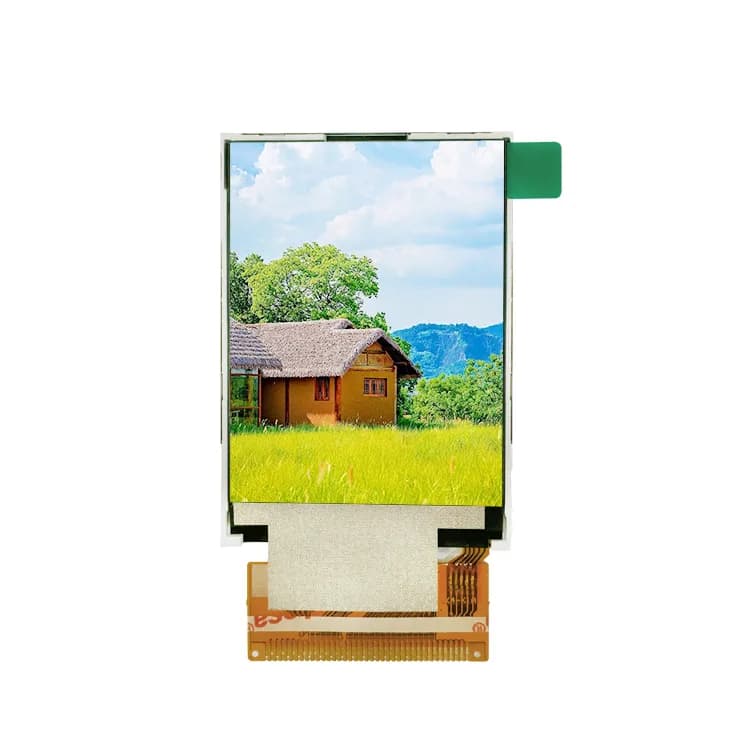
Specifications
| Diagonal size | 2.8" |
|---|---|
| Resolution | 240×320 |
| Panel type | IPS |
| Interface | SPI / MCU (8080 parallel) |
| Driver IC | ILI9341 |
| Touch | Capacitive (CTP) |
| Brightness | 300 cd/m² (nits) |
| Viewing angle | 80/80/80/80 |
| Colors | 262K |
| Operating temp. | -20 to +70 °C |
| Outline (mm) | 50.0×69.2×3.9 |
| FPC / connector | 40-pin · 0.5 mm FPC |
| Supply voltage | 3.3V |
Engineering notes
SPI or parallel?
Over SPI at 40 MHz a full 240×320 frame takes about 31 ms. That is fine for dashboards and LVGL UIs with partial updates. If you need full-screen animation, the 8080 16-bit parallel mode on the same FPC raises throughput several-fold on MCUs with an FSMC/FMC or LCD peripheral.
Touch
The capacitive touch controller connects over I2C with an interrupt line. Map the touch coordinates to the display rotation you use; most UI frameworks handle this with a single swap/mirror setting.
IPS vs the classic TN version
Many 2.8″ ILI9341 modules on the market are TN panels with narrow viewing angles. This module uses an IPS panel, so the image does not invert when viewed from below. That matters for wall-mounted and handheld products.
Driver reference: ILI9341.
Integration
Integration calculations
Figures below are calculated from the DE-280-SPI-CTP’s 240×320 resolution and SPI / MCU (8080 parallel), so you can size the host before requesting samples. Refresh rates are theoretical bus limits; real throughput is lower once command overhead and rendering time are included.
| Pixel density | 143 PPI |
|---|---|
| Native orientation | Portrait (240×320); rotate in the driver for landscape UIs |
| Full frame buffer | 150 KB at RGB565 · 225 KB at RGB888 |
| SPI full-frame refresh (RGB565, theoretical) | 33 fps at 40 MHz · 65 fps at 80 MHz |
| 8080 parallel refresh (theoretical, 10 MHz WR) | 100+ fps on a 16-bit bus · 65 fps on an 8-bit bus |
At 300 cd/m² it is sized for indoor use; the backlight can be upgraded for brighter environments.
Hosts with a native SPI / MCU (8080 parallel) peripheral
SPI up to 80 MHz; the 150 KB RGB565 frame fits in internal SRAM.
- STM32, RP2040, nRF52
Any MCU with an SPI peripheral and DMA; partial-buffer rendering keeps RAM use low.
LCD_CAM peripheral drives 8/16-bit 8080 (i80) panels with DMA.
- STM32 with FSMC/FMC
The external memory controller maps the panel as memory for fast writes.
Interface support is based on each processor’s published display peripherals, not a bench test of this module. Ask us for tested init code.
Alternatives in the catalog
Other 2.8" options
- PJ2805H05-30H45P3002.8" 240×320 · MCU (8080 parallel) · TN · 300 nits
- PJ2805H03-30H45P3002.8" 240×320 · MCU (8080 parallel) · TN · 300 nits
- PJ2802V03-26H37P2602.8" 240×320 · interface on request · 260 nits
- PJ2801H05-23H30P2502.8" 240×320 · SPI · TN · 250 nits
- PJ2801H22-23H10P2002.8" 240×320 · SPI · TN · 200 nits
- PJ2701G01-28H40P2002.7" 960×240 · RGB (parallel) · TN · 200 nits
240×320 in other sizes
- PJ3202H01-36H45P300R3.2" 240×320 · SPI / MCU (8080 parallel) / RGB (parallel) · TN · 300 nits
- PJ2403I06-22H36P3002.4" 240×320 · interface on request · 300 nits
- PJ2403I02-22H10P3002.4" 240×320 · SPI · TN · 300 nits
- PJ2401I24-22H30P2502.4" 240×320 · SPI · TN · 250 nits
- PJ2401I02-22H38P3002.4" 240×320 · MCU (8080 parallel) · TN · 300 nits
- PJ2401H28-22H45P2002.4" 240×320 · SPI / MCU (8080 parallel) / RGB (parallel) · IPS · 200 nits
Frequently asked questions
Is this display compatible with the ESP32 Cheap Yellow Display code?
The display driver (ILI9341, 240×320) is the same family, so most CYD display code works with pin changes. The touch controller differs (capacitive I2C instead of XPT2046 resistive), so update the touch driver.
Can I use the 8080 parallel interface?
Yes. Select the interface with the IM pins as described in the datasheet. Parallel mode is much faster for full-screen updates.
What is the operating temperature?
-20 to +70 °C. Wide-temperature versions can be discussed for outdoor products.
What is the brightness of the DE-280-SPI-CTP?
300 cd/m² typical with the standard backlight. At 300 cd/m² it is sized for indoor use; the backlight can be upgraded for brighter environments.
What interface does the DE-280-SPI-CTP use?
SPI / MCU through a 40-pin FPC. Pin definition and timing are in the datasheet, which you can request on this page.
Which processors can drive the DE-280-SPI-CTP?
ESP32 / ESP32-S3: SPI up to 80 MHz; the 150 KB RGB565 frame fits in internal SRAM. STM32, RP2040, nRF52: Any MCU with an SPI peripheral and DMA; partial-buffer rendering keeps RAM use low. ESP32-S3: LCD_CAM peripheral drives 8/16-bit 8080 (i80) panels with DMA. STM32 with FSMC/FMC: The external memory controller maps the panel as memory for fast writes.
Does the DE-280-SPI-CTP have a touch panel?
Yes, a capacitive (CTP) touch panel. The non-touch version and other cover-glass options can be built.
What is the MOQ and lead time for the DE-280-SPI-CTP?
Samples start from 1 pc. Production MOQ and lead time depend on quantity and any customization (FPC length, backlight, touch), and are agreed per project with our sales team. Send your annual volume and target date for a quote.