Waveshare ESP32-S3-Touch-LCD-1.28 display: specs, driver revisions & setup
A 1.28-inch round 240×240 IPS display board with a GC9A01 controller, CST816S touch and a QMI8658 IMU on ESP32-S3: a common base for watch faces and knob interfaces.
Waveshare ESP32-S3-Touch-LCD-1.28 display specifications
Which Waveshare ESP32-S3-Touch-LCD-1.28 revision do you have?
Known display configuration for this board.
| Revision | Driver IC | How to identify | Library settings |
|---|---|---|---|
| ESP32-S3-Touch-LCD-1.28 | GC9A01 | Waveshare's specification table lists the driver as GC9A01A. The SoC is marked ESP32-S3R2 or ESP32-S3RH2; both carry 2 MB PSRAM. | TFT_eSPI: GC9A01_DRIVER; LovyanGFX: Panel_GC9A01. RIOT's board config sets colour inversion on and BGR colour order. |
Waveshare ESP32-S3-Touch-LCD-1.28 display and touch pins
| Signal | GPIO | Notes |
|---|---|---|
| LCD SCLK | 10 | SPI (SPI2 / FSPI in RIOT) |
| LCD MOSI | 11 | SPI |
| LCD MISO | 12 | SPI, LCD SDO; only needed to read from the GC9A01 |
| LCD CS | 9 | |
| LCD DC | 8 | |
| LCD RST | 14 | |
| Backlight | 2 | Brightness control (PWM) |
| Touch/IMU SDA | 6 | I2C, shared by CST816S and QMI8658 |
| Touch/IMU SCL | 7 | I2C |
| Touch INT | 5 | CST816S |
| Touch RST | 13 | CST816S |
| Battery voltage | 1 | ADC, through a 200 kΩ / 100 kΩ divider |
| BOOT button | 0 | Active low; usable as a user button |
| UART TXD | 43 | To the CH343P USB-UART chip |
| UART RXD | 44 | To the CH343P USB-UART chip |
Same display spec for volume production
Prototyped on the Waveshare ESP32-S3-Touch-LCD-1.28? These modules from our direct factories share the panel size and resolution, come with a datasheet and a fixed driver IC per production lot, and are available from 1 pc samples. MOQ and lead time are agreed per project.
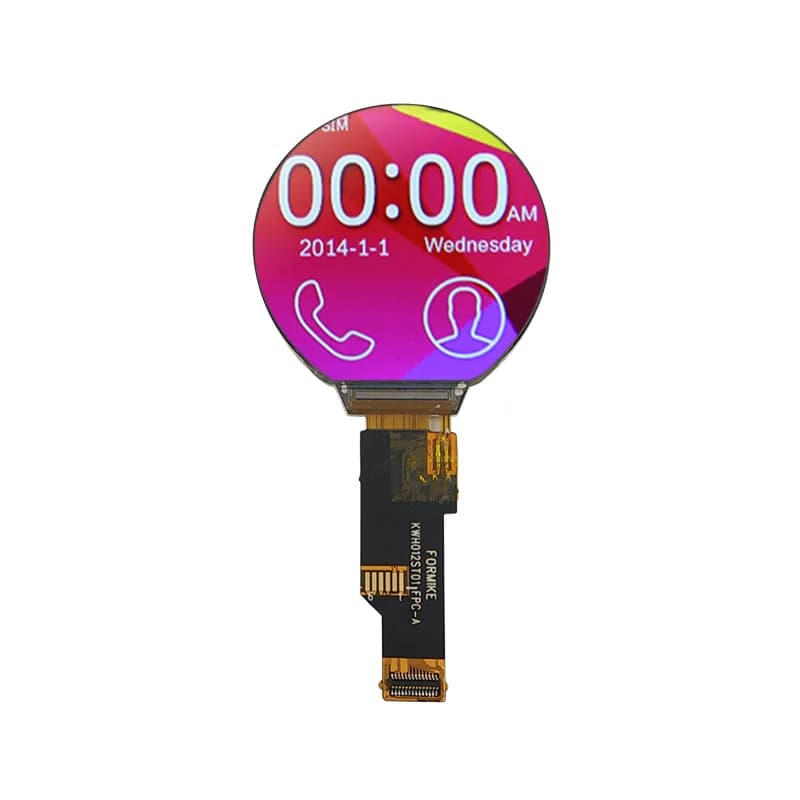
From Waveshare ESP32-S3-Touch-LCD-1.28 prototype to production
Dev boards are ideal for proving a UI, but their panels are bought on the open market: the controller can change between batches, there is rarely a datasheet, and lifetime is not guaranteed. For a product, specify a module with a fixed driver IC per production lot, a datasheet and a lifecycle commitment.
Our direct factories build modules with the same 1.28″ 240×240 format. Samples start at 1 pc; MOQ and lead time are agreed per project with our sales team.
Before you debug code
- Confirm which revision you have (table above): driver IC changes are the most common cause of a white screen.
- Check the backlight pin is not reused in your sketch.
- Change one setting at a time (driver, inversion, colour order), and keep a known-good example to compare against.
Configuration examples
#define GC9A01_DRIVER
#define TFT_WIDTH  240
#define TFT_HEIGHT 240
#define TFT_SCLK 10
#define TFT_MOSI 11
#define TFT_CS    9
#define TFT_DC    8
#define TFT_RST  14
#define TFT_BL    2
#define SPI_FREQUENCY 40000000// Battery -> 200k / 100k divider -> GPIO 1 (Waveshare formula)
float readBatteryVolts() {
int raw = analogRead(1); // 12-bit: 0..4095
return 3.3f / 4096.0f * 3.0f * raw;
}Guides & comparisons
CST816S Touch Not Working? I2C Scan, Chip ID, Interrupt and Sleep Fixes
A step-by-step checklist for a CST816S capacitive touch controller that isn't found on I2C, fails at start-up, gives no touch events or reports the wrong coordinates, with the settings for ESPHome, ESP-IDF, Arduino and Linux.
Guide1.28-inch Round Display with ESP32 (GC9A01): Wiring, Libraries and Round-UI Tips
A step-by-step build: wire a 240×240 GC9A01 round TFT to an ESP32-S3, configure TFT_eSPI, LovyanGFX or ESP-IDF, size LVGL buffers, and lay out a UI that fits the circle.
Frequently asked questions
Why does touch return zero coordinates?
The CST816S shares the I2C bus (SDA 6, SCL 7) with the IMU and needs its reset (GPIO 13) released; check the I2C setup and address before debugging the driver.
Which display driver and settings does the Waveshare ESP32-S3-Touch-LCD-1.28 need?
The panel uses a GC9A01 (Waveshare lists GC9A01A) at 240×240 over 4-wire SPI. RIOT's board definition runs it with colour inversion on and BGR colour order. If colours look inverted or red and blue are swapped, those are the two settings to check.
Which GPIO is the backlight on?
GPIO 2. Waveshare states that GPIO 2 controls backlight brightness, so it can be driven with PWM. If the screen stays dark while the code runs, check that GPIO 2 is set high.
How fast can the SPI bus run?
Waveshare states SPI speeds up to 80 MHz for this board. RIOT's default for it is a conservative 10 MHz. A full 240×240 RGB565 frame is 115,200 bytes, so 40 MHz already allows about 43 full frames per second before overhead.
How do I read the battery voltage?
The battery is connected to GPIO 1 through a 200 kΩ / 100 kΩ divider, so the pin sees one third of the battery voltage. Waveshare's formula is 3.3 / 4096 × 3 × the ADC reading.
How much flash and PSRAM does the board have?
Waveshare lists an ESP32-S3R2 (or ESP32-S3RH2) with 2 MB of PSRAM in the package and a 16 MB W25Q128JVSIQ NOR flash. With 2 MB of PSRAM, keep LVGL buffers and images small: one full 240×240 RGB565 buffer is 115,200 bytes.
Which GPIOs are free for my own hardware?
Six GPIOs are brought out on the SH1.0 connector; Waveshare's pin definition drawing shows which ones. Waveshare's documentation also mentions two MOSFET-switched pads near the battery holder on GPIO 4 and GPIO 5, while RIOT uses GPIO 5 as the touch interrupt. Check the schematic before driving a load from GPIO 5.
Sources
Not sure which display fits your design?
Send us your size, interface and host processor. A display engineer replies within 12 hours with 2–3 options, datasheets and init code. Samples from 1 pc.