Specifications
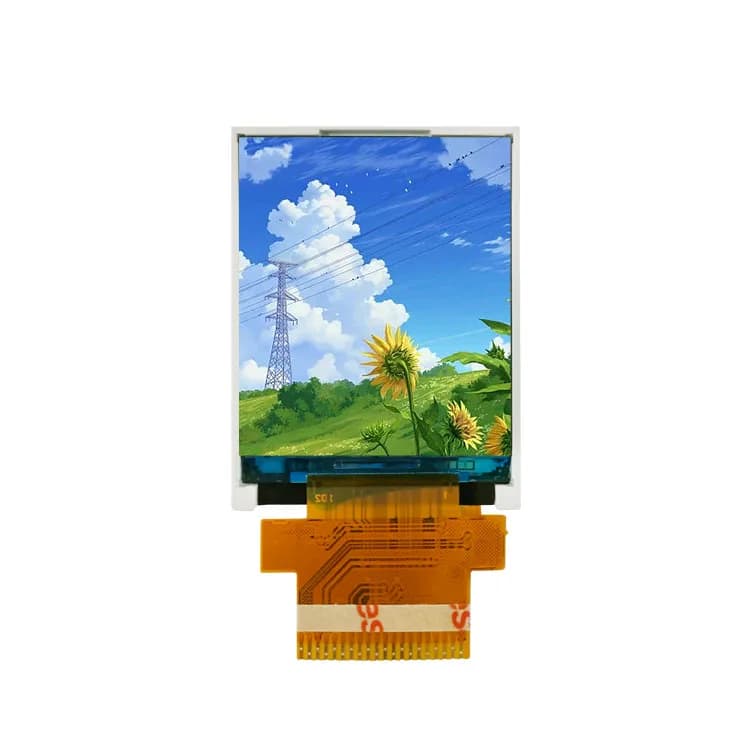
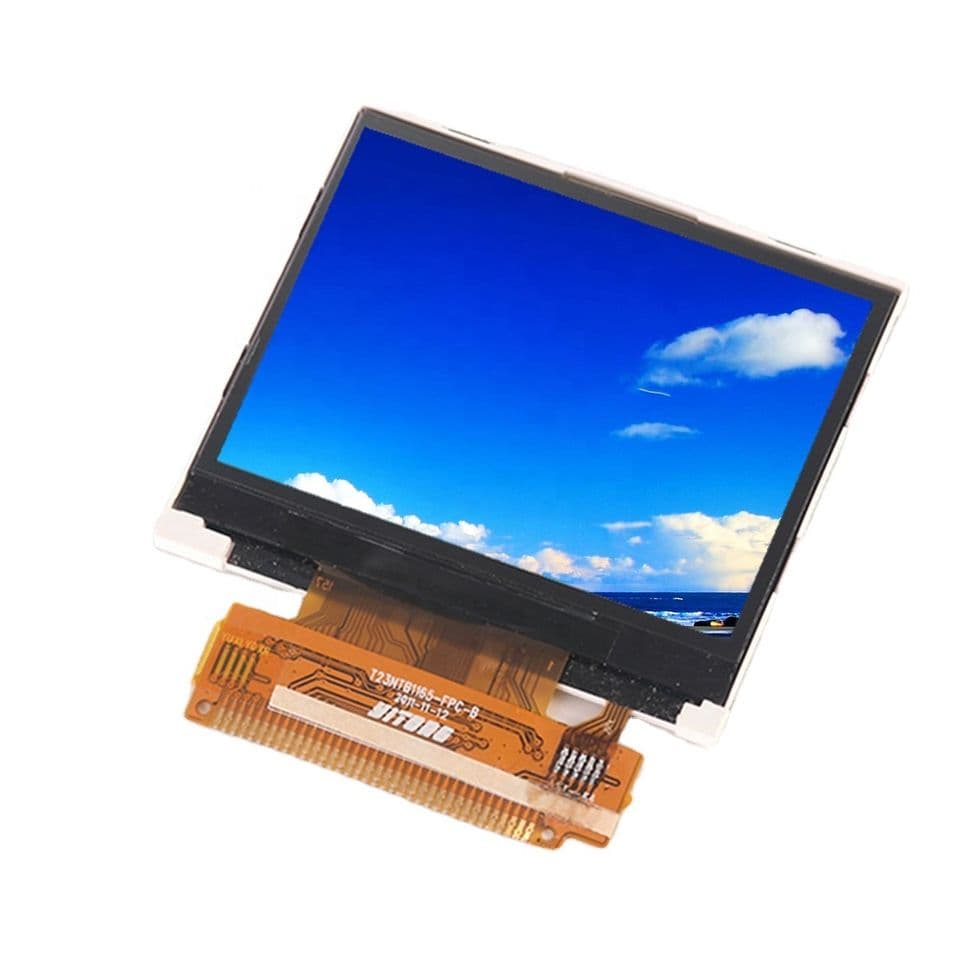
| Diagonal size | 2.3" |
|---|---|
| Manufactured by | Shenzhen PengJi Photoelectricity Co., Ltd. (direct factory) |
| Resolution | 320×240 |
| Panel type | IPS |
| Interface | SPI / RGB (parallel) |
| Driver IC | ILI9342C |
| Touch | None |
| Viewing angle | Full viewing angle (all directions) |
| Operating temp. | -20 to +70 °C |
| Outline (mm) | 55.20(W)*47.55(H)*2.8(T) mm |
| Active area (mm) | 46.75(W)*35.06(H) mm |
| Backlight | 4 white LEDs, parallel |
| FPC / connector | 40-pin · 0.5 mm pitch FPC |
Data sources
- Specifications from the product page of the factory that builds the PJ2302T01-28H40P (Shenzhen PengJi Photoelectricity Co., Ltd.).
- Specs transcribed from the spec-chart image on the source page; verify against the datasheet.
- Confirm final values against the datasheet supplied with samples.
Integration
Integration calculations
Figures below are calculated from the PJ2302T01-28H40P’s 320×240 resolution and SPI / RGB (parallel), so you can size the host before requesting samples. Refresh rates are theoretical bus limits; real throughput is lower once command overhead and rendering time are included.
| Pixel density | 174 PPI |
|---|---|
| Native orientation | Landscape (320×240) |
| Full frame buffer | 150 KB at RGB565 · 225 KB at RGB888 |
| SPI full-frame refresh (RGB565, theoretical) | 33 fps at 40 MHz · 65 fps at 80 MHz |
| RGB pixel clock for 60 Hz | ≈ 5.5 MHz (incl. ~20% blanking) |
| RGB bus width | 24 data lines (16.7M colors) + PCLK, HSYNC, VSYNC, DE; can be wired as 16-bit RGB565 with the low bits tied |
Hosts with a native SPI / RGB (parallel) peripheral
SPI up to 80 MHz; the 150 KB RGB565 frame fits in internal SRAM.
- STM32, RP2040, nRF52
Any MCU with an SPI peripheral and DMA; partial-buffer rendering keeps RAM use low.
RGB LCD peripheral (16-bit RGB565) with the 150 KB frame buffer in PSRAM.
- STM32 with LTDC
F429/F7/H7 families drive 16- to 24-bit RGB panels from external SDRAM.
- Raspberry Pi (DPI)
Parallel RGB over the GPIO header via the DPI overlay.
Interface support is based on each processor’s published display peripherals, not a bench test of this module. Ask us for tested init code.
Alternatives in the catalog
Other 2.3" options
- PJ2301H10-23H37P4502.3" 320×240 · MCU (8080 parallel) · TN · 450 nits
- PJ2301T03-23H40P4002.3" 320×240 · RGB (parallel) · TN · 400 nits
- PJ2301H09-23H40P3502.3" 320×240 · RGB (parallel) · TN · 350 nits
- PJ2403I06-22H36P3002.4" 240×320 · interface on request · 300 nits
- PJ2403I02-22H10P3002.4" 240×320 · SPI · TN · 300 nits
- PJ2401I02-22H38P3002.4" 240×320 · MCU (8080 parallel) · TN · 300 nits
320×240 in other sizes
- PJT350P15H50-400P54C3.5" 320×240 · RGB (parallel) · TN · 400 nits
- PJ3502B01-32H54P4003.5" 320×240 · RGB (parallel) · IPS · 400 nits
- PJ3501I01-34H54P3003.5" 320×240 · RGB (parallel) · IPS · 300 nits
- PJ2501G01-25H51P3002.6" 320×240 · RGB (parallel) · TN · 300 nits
- PJ2002G11-30H40P2002" 320×240 · RGB (parallel) · TN · 200 nits
- PJ2002C25-37H40P200R2" 320×240 · interface on request · TRANSFLECTIVE · 200 nits
Frequently asked questions
What interface does the PJ2302T01-28H40P use?
SPI / RGB through a 40-pin FPC. The driver IC is the ILI9342C. Pin definition and timing are in the datasheet, which you can request on this page.
Which processors can drive the PJ2302T01-28H40P?
ESP32 / ESP32-S3: SPI up to 80 MHz; the 150 KB RGB565 frame fits in internal SRAM. STM32, RP2040, nRF52: Any MCU with an SPI peripheral and DMA; partial-buffer rendering keeps RAM use low. ESP32-S3: RGB LCD peripheral (16-bit RGB565) with the 150 KB frame buffer in PSRAM. STM32 with LTDC: F429/F7/H7 families drive 16- to 24-bit RGB panels from external SDRAM. Raspberry Pi (DPI): Parallel RGB over the GPIO header via the DPI overlay.
What is the MOQ and lead time for the PJ2302T01-28H40P?
Samples start from 1 pc. Production MOQ and lead time depend on quantity and any customization (FPC length, backlight, touch), and are agreed per project with our sales team. Send your annual volume and target date for a quote.